Luciferase Assay Reagent
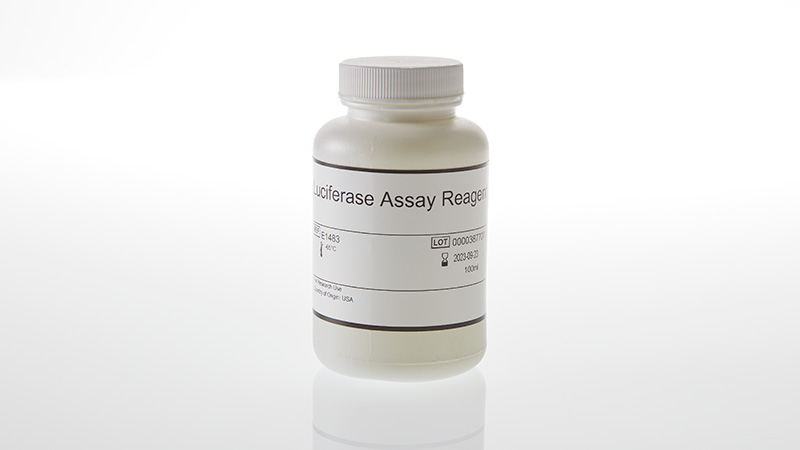
Ready-to-Use Reagent for Detection of Firefly Luciferase Activity
- Convenient premixed reagent containing Luciferase Assay Substrate and Buffer
- Component of Luciferase Assay System (Cat.# E1500, E1501)
- Linear over eight or more orders of magnitude of enzyme concentration
- Sensitive to 10–20 moles of luciferase

Catalog Number:
Size
Catalog Number: E1483
Simple Non-Homogenous Assay to Quantify Firefly Luciferase Activity
The Luciferase Assay System is an extremely sensitive and rapid reagent for quantitation of firefly luciferase. Linear results are seen over at least eight orders of magnitude of enzyme concentration, and less than 10–20 moles of luciferase can be measured under optimal conditions. Generally, 100-fold greater sensitivity can be achieved over the chloramphenicol acetyltransferase (CAT) assay.
The Luciferase Assay Reagent generates light that is nearly constant for at least 1 minute and so the assay is compatible with measurement of luciferase using a single-tube luminometer or a multiwell plate luminometer with an auto-injector. A luminometer is preferred, but not required as the assay is adaptable to scintillation counters.
Cell Lysis Reagents used with the Luciferase Assay System
The Luciferase Assay System is a nonhomogeneous assay; the cells containing the luciferase must be lysed before reagent addition. Glo Lysis Buffer (Cat.# E2661), Cell Culture Lysis Reagent (Cat.# E1531), Passive Lysis Buffer (Cat.# E1941) and Reporter Lysis Buffer (Cat.# E3971) can be used with the Luciferase Assay System for reporter quantitation in mammalian cells. Reporter Lysis Buffer enables luciferase, CAT and β-galactosidase assays to be performed from the same cell extract. The Luciferase Assay System also can be used for quantitation in plant and bacterial cells, but only Cell Culture Lysis Reagent is suitable for these applications.
In some kits the lysis buffer is included, and in others it must be purchased separately (see the Specifications section of this page to view assay components).
References
- Wood, K.V. (1991) In: Bioluminescence & Chemiluminescence: Current Status, eds. P. Stanley and L. Kricka, John Wiley & Sons, Ltd., Chichester, 543.
- Seliger, H.H. and McElroy, W.D. (1960) Arch. Biochem. Biophys. 88, 136.
- Wood, K.V. et al. (1984) Biochem. Biophys. Res. Comm. 124, 592–6.
- de Wet, J.R. et al. (1985) Proc. Natl. Acad. Sci. USA 82, 7870–3.
- Alam, J. and Cook, J.L. (1990) Anal. Biochem. 188, 245–54.
- Schenborn, E. and Goiffon, V. (1993) Promega Notes 41, 11–3.
- Jones, D.P. et al. (1995) Promega Notes 54, 20–5.
Protocols
Complete Protocol
Quick Protocols
Specifications
Catalog Number:
SDS
Search for SDSCertificate of Analysis
Use Restrictions
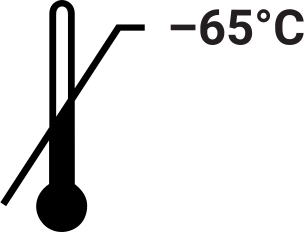
For Research Use Only. Not for Use in Diagnostic Procedures.Storage Conditions
Resources
No related resources available
Related Products
Similar Products
Nano-Glo® Luciferase Assay System
Add-mix-measure assay for NanoLuc® Luciferase with >2 hour half-life in most applications.
N1110, N1120, N1130, N1150
Bright-Glo™ Luciferase Assay System
A sensitive reporter assay for continuous-processing on robotic systems.
E2610, E2620, E2650
Steady-Glo® Luciferase Assay System
A sensitive reporter assay with long-lived luminescence for batch processing in multiwell plates.
E2510, E2520, E2550
Dual-Glo® Luciferase Assay System
Consecutive detection of firefly and Renilla luciferase activities in a single sample. Two-hour signal half-life. No injectors required.
E2920, E2940, E2980
Frequently Used With
Glo Lysis Buffer
Promotes rapid lysis (5 minutes) of cultured mammalian cells without scraping or freeze-thaw cycles.
E2661
GloMax® Explorer System
Easy-to-use, flexible multimode detection system.
GM3500, GM3510
GloMax® Navigator System
Dedicated microplate luminometer.
GM2000, GM2010
GloMax® Discover System
High-performance microplate reader for detecting luminescence, fluorescence and absorbance.
GM3000